FHElium branding
FHElium's identity connects fully homomorphic encryption with the compact, layered structure of a helium nucleus. The name, nucleus mark, color system, and typography express one engineering principle: sophisticated encrypted execution should be assembled from a small set of typed, inspectable interfaces, invariants, and requirements.
Name and pronunciation
The name is formed by placing F before helium:
F + helium = FHElium
The capitalization makes the first three letters, FHE, immediately visible while retaining helium as the spoken and visual base. Use FHElium for the project and product name, and use lowercase fhelium for the Python package, import path, command, and filesystem namespace.
Two pronunciations are accepted:
| Spoken form | IPA | Use |
|---|---|---|
| “philium” | /ˈfɪliəm/ | Compact conversational reading |
| “F-helium” | /ˌɛf ˈhiːliəm/ | Letter-by-letter reading that emphasizes FHE |
Written technical material should retain the prescribed FHElium capitalization regardless of the spoken form.
Shape
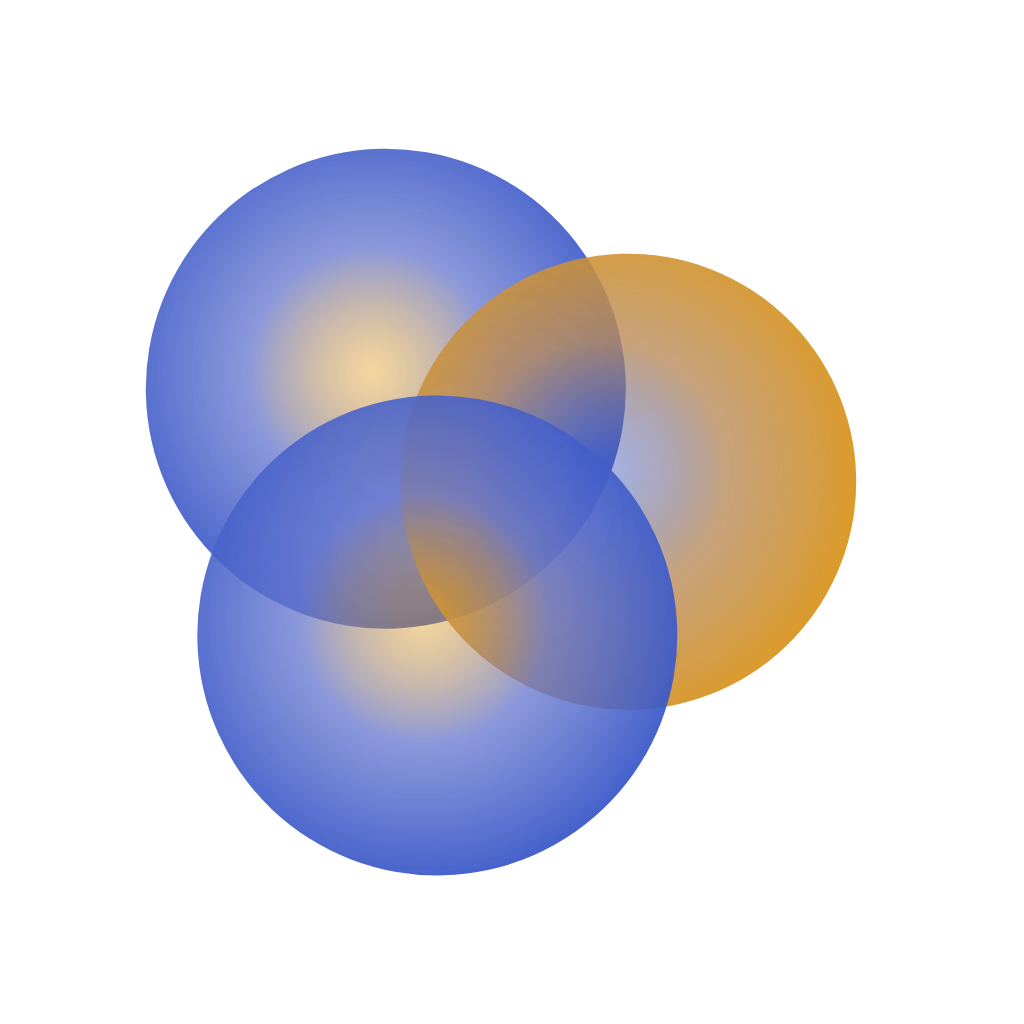
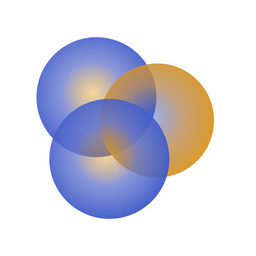
The mark abstracts the helium-3 nucleus as three overlapping circular fields: two proton fields and one neutron field. Their overlap forms one compact body without erasing the outline of any constituent field. The 12.7-degree rotation prevents the construction from reading as a static diagram and gives the mark a directional, computational character.
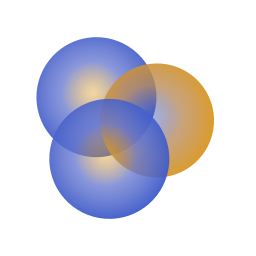

The construction is an identity abstraction rather than a physical particle diagram. Circle positions, radii, opacity, and color encode visual hierarchy; they do not represent measured nuclear geometry or particle color.
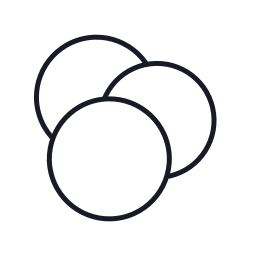
The monochrome construction keeps every field opaque and gives each sphere a continuous contrast outline. Drawing the spheres from back to front lets the outlines meet cleanly while making the front-to-back ordering visible.
Design philosophy
The nucleus reflects FHElium's engineering model: distinct layers overlap through defined interfaces to form one compact, coherent system. Cobalt carries the technical structure, while helium amber adds identity and emphasis without obscuring the relationships being shown.
Color system
#3152C7Primary structure and proton fields#E39A13Identity accent and neutron field#181B26Wordmark and primary light-theme text#F7F7F2Primary light surface#11131APrimary dark surfaceThe source logo uses cobalt #3152C7, amber #E39A13, spectral blue #6677CF, and warm bridge #B88A5A. Interface colors may raise luminance for dark-mode readability; the source logo colors remain unchanged.
Download assets
Horizontal lockups
| Asset | Format | Intended surface |
|---|---|---|
| Primary dark-text lockup | SVG | Light or warm-neutral background |
| Primary light-text lockup | SVG | Dark-neutral background |
| Monochrome black lockup | SVG | One-color light output |
| Monochrome white lockup | SVG | One-color dark output |
Standalone vector marks
| Asset | Format | Use |
|---|---|---|
| Primary gradient mark | SVG | Default standalone mark |
| Flat-color mark | SVG | Small sizes and restricted renderers |
| CSS-colorable monochrome mark | SVG | currentColor-controlled integration |
| Fixed black mark | SVG | One-color light output |
| Fixed white mark | SVG | One-color dark output |


Transparent raster marks
| Construction | Downloads |
|---|---|
| Primary gradient | 1024 px · 512 px · 256 px · 128 px |
| Flat color | 256 px · 128 px · 64 px · 32 px · 16 px |
| Monochrome | Black, 256 px · White, 256 px |






All raster assets use transparent backgrounds. Select the fixed white assets only when the destination surface is known to be dark; transparent image viewers commonly display them against white.